Eastern Colorado’s farm golf courses survive through the love and sweat of the people who play them
WORDS AND PHOTOS BY JIM BEBBINGTON
Scott Jones, the brother of U.S. Open winner Steve Jones, is working these days as the superintendent of Indian Hills Golf Course – the 9-holer in their hometown of Yuma, Colorado.
Aaron Prior, an insurance broker in Yuma, Colorado, and one of the board members for the Yuma Golf Club.
Yuma has a population of around 3,500 and is the hub for a farm and ranching community that extends miles in every direction into the eastern Colorado plains. It is off the beaten path –miles south of the nearest major Interstate, I-76, and 150 miles east of Denver.
There are many mornings when Jones is cutting grass at 5:55 a.m. when the Amtrak train headed to Denver roars by on the tracks that run right along the edge of the course and through the middle of downtown. He always turns and waves.
The course is a labor of love for Jones and most of the members. Aaron Prior, an insurance risk advisor in town, is on the board of the course and just started helping coach the Yuma High School girls’ golf team.
“We have roughly 235 members – this is ag country, so it’s a lot of farmers, a lot of insurance guys, a lot of bankers,” Prior said.
A pond on No. 7 needs to be re-lined, but that project will probably have to wait until fall when some member – it’s not clear who yet – will volunteer their skills and earthmoving equipment to make it happen. The irrigation system – crucial for saving the greens when the summer rains don’t come – needs an upgrade that could cost $1.3 million.
On the weekend, rounds cost $36 to play the course twice. Kids play for $5.
Some members store their golf carts in the barn. Playing a recent round with a guest, Jones borrowed one that was outfitted by its owner, a local farmer, with air conditioning. It topped out at nearly 35 miles an hour.
Scott Jones
“He does everything fast,” Jones said of the cart’s owner.
The nine fairways are lined with pine, maple and other trees, and every single one of them was beaten to a pulp in a biblical May 2024 hailstorm that took Jones and his crew two weeks to recover from. The greens were pockmarked like focaccia. But for all the toil it takes to keep Indian Hills running, Jones and the rest of the people who run the course are glad to have it at all.
They know they have something that thousands of Colorado golfers wish they had too – a nice golf course up the street from home where it’s very easy to get a tee time and doesn’t charge an arm and a leg.
Yuma’s course exists because a bunch of farmers in 1971 decided they wanted one. The current members once knew who the course designer was, but after the clubhouse was renovated 10 years ago or so, they lost track of their historical photos, including the one with the architect’s name written on it.
But through it all – summer droughts that turn the rough to ash; punishing hail; winds that some days seem like they never stop; this spring’s weird wet weather – they keep it running. It’s a source of pride, and the course has woven itself into the fabric of this small town for a generation. Do not, according to retired farmer Lyle Smith, try to get ahold of a local farmer on Thursdays during the summer.
That’s men’s league day. “The whole town damn-near shuts down,” Smith said. And woe to the male golfer who pulls into the parking lot on Wednesdays. That’s ladies league day. That is their time, and men best busy themselves elsewhere.
Jones remembers playing with his older brother Steve on the course as a kid.
The photos they have at home show them in their 1970s shorts, maybe having ridden bikes with banana seats through town with their clubs, playing among tiny trees and skies that made you think you could see to the end of the world. “If you’re going to put this in the magazine, say I beat Steve all the time,” Scott Jones said.
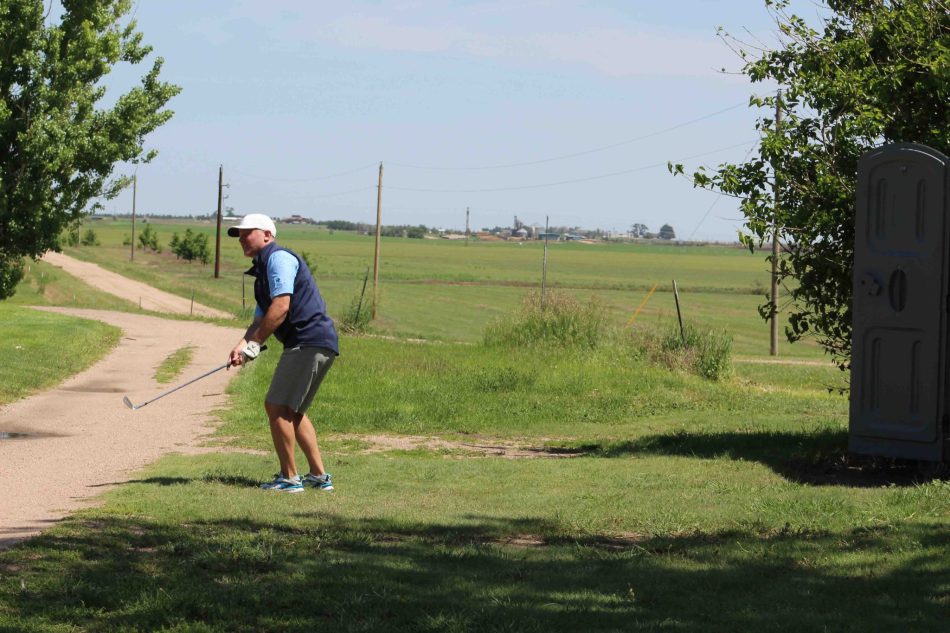
The vibe is relaxed. Players wear everything from camo t-shirts and work boots to the latest in golf-wear. A five-some of teenage boys played one Saturday afternoon recently by piling three players in the seats of the cart and two more standing on the sides of the cart, holding onto the roof.
“The only thing I have never understood is the best part of the entire golf course is where they put the clubhouse and the driving range and the parking lot,” Smith said, who has played here since he moved to town in 1974. Indian Hills gets serious right out of the gate. The first three holes start out par 5,4,5. “It’s all in front of you,” Prior said. “There’s not much (mystery) to it, but it’s all you can handle.”Courses like Indian Hills dot the eastern plains. From Yuma, you can get to courses in Akron, Wray and Toledo all within an hour. Arguably, the greatest course in the state – Ballyneal – is an hour’s drive to the east.
“Golf is strong in Yuma, Colorado,” Prior said.
Jim Bebbington is the Director of Content at Colorado AvidGolfer and can be reached at [email protected]
Colorado AvidGolfer Magazine is the state’s leading resource for golf and the lifestyle that surrounds it, publishing eight issues annually and proudly delivering daily content via coloradoavidgolfer.com.
Want to increase golf swing speed and hit longer drives? Learn two simple ways to add clubhead speed, improve hip rotation, and create more distance off the tee.
The Japanese brand that’s part of Dunlop Sports appears to be disrupting conventional launch dates with the September/October releases of its latest equipment