A look back at the defining moments from a century and a half of golf in the Centennial State
By Jon Rizzi
The histories of Colorado statehood and Colorado golf both go back 150 years-maybe.
There is murky legend that in 1876 – the year of Colorado’s founding-an Anglo-Irish aristocrat named Windham Thomas Wyndham-Quinn-the Fourth Earl of Dunraven-may have been swatting a featherie with a baffie somewhere on the 6,000 scenic acres he had unscrupulously acquired in Estes Park.
Little evidence supports that claim other than legend, but we do know that the earl built the Estes Park Hotel around that time but left the area by the mid-1880s, eventually selling his vast acreage to the Estes Park Development Company, which opened a golf course in 1918.
A more plausible founding for Colorado golf is Denver’s exclusive Overland Park Club, where member Henry Wolcott introduced the game to members in 1887. Formally-clad men and women immediately cottoned to this healthful form of conspicuous leisure, and a course gradually took shape across the club’s horse-racing track.
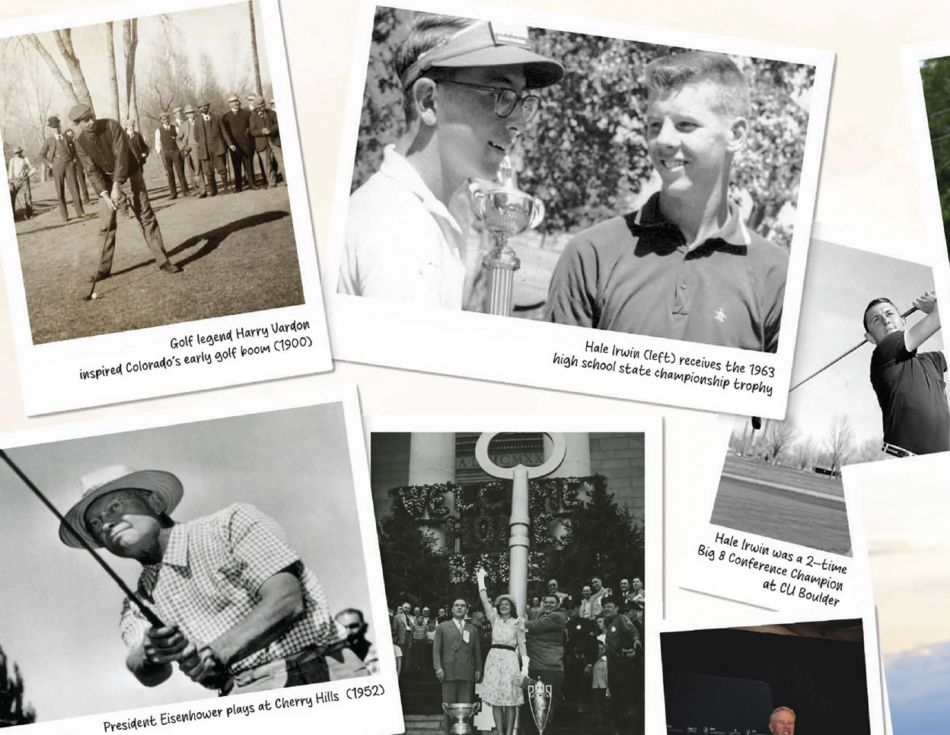
Situated along the South Platte River, Overland in 1896 would become the first USGA member club west of the Mississippi. Four years later, true golf aristocracy arrived in Colorado in the form of three-time Open Champion Harry Vardon, who played a 36-hole exhibition match at Overlandhis ball against the best ball of the club’s top three players-and won 3 and 2.
The match, staged to promote his Vardon Flyer golf ball, generated publicity and popularized golf in Colorado, as did the two 18-hole matches Var-don played the next day at Colorado Springs’ Town and Gown Club. The afternoon match, which end-ed all-square, featured club president William K. Jewett, who would later buy the club and deed it to the city as a municipal course renamed in honor of his late wife. Since 1919, Patty Jewett Golf Course has seen more rounds than almost any other course in the state.
By 1920, Overland had also changed its name, having reincorporated years earlier as Denver Country Club and moving to its current location along Cherry Creek. It was by that time one of at least two dozen courses-mostly private but some municipal and resort-that had sprung up in Grand Junction, Trinidad, Pueblo, Colorado Springs, Fort Collins, Greeley, Fort Morgan, Bou I-der, Evergreen, Estes Park and Glenwood Springs. City Park, Denver’s first public golf course, opened in 1913.
Play at City Park’s Tom Bendelow layout increased exponentially, with its 633-yard, par-5 13th being one of the longest holes in America.
During the Roaring 20s Cherry Hills and Green Gables joined Denver and Lakewood among elite private country clubs. Golf endured the Great Depression-which saw the private Wellshire Country Club and its Donald Ross course become property of the City of Denver, Cherry Hills host the 1938 U.S. Open and “Lakewood Lass” Phyllis Buchanan establish a record of six state match play titles, with five of them coming consecutively (1935-39).

The decade wasn’t without scandal, either. In 1934, a prominent “clubman” described by a New York tabloid as “Denver’s richest and handsomest bachelor” was murdered in his car by a paramour he refused to marry and then turned the gun on herself. He left $60,000 (worth roughly $1.5 million in 2026) to Denver to build a golf course. The city, which owned the nine-hole Berkeley Park Course in northwest Denver, used the money to combine it with the adjacent Rocky Mountain Country Club/Shrine Course nine, and christen the new layout in the name of the late Casanova: Willis Case.
After World War II, golf’s popularity swelled. On July 3, 1947, to celebrate Edgewater resident “Babe” Didrikson Zaharias becoming the first American to win both the U.S. Women’s Amateur and British Ladies’ Amateur, more than 50,000 people lined the parade route and crowded into Civic Center Park to watch her receive a 14-foothigh, 250-pound key to the city. The following year, U.S. Open Champion Ben Hogan notched his sixth consecutive PGA Tour victory at the Denver Open at Wellshire.
In the 1950s President Dwight Eisenhower-who averaged more than 100 rounds in each of his eight years in office and whose in-laws lived in Denver- made golf in Colorado increasingly popular. The decade ended with a pair of momentous national victories in the Centennial State: Jack Nicklaus won the 1959 U.S. Amateur at The Broad moor and Seattle’s Bill Wright captured the 1959 U.S. Public Links at Wellshire to become the first African American to win a USGA championship.
In 1962, the year after the PGA of America dropped its “Caucasian-Only” membership clause, the Colorado Golf Association-one of the USGA’s 55 allied associations-began admitting members of “minority clubs” to compete in its events. In terms of overall impact, however, nothing compares to the telegenic, swashbuckling, visor-tossing Arnold Palmer. During his epic comeback from seven shots down to win the 1960 U.S. Open at Cherry Hills, the “massive roars reverberated across the course, applying immense pressure to his rivals,” according to The Denver Post.
In the later part of the 20th century Coloradans like Dale Douglass, Hale Irwin and Steve Jones were winning PGA Tour events (including four U.S. Opens and a U.S. Senior Open); The Broadmoor’s Judy Bell became the USGA’s first female president; and clubs such as Denver, The Broadmoor, Columbine and Cherry Hills attracted large galleries with PGA Tour, LPGA Tour and USGA championships.
The International Tournament was played at Castle Pines Golf Club from 1986 to 2006, the region’s only annual stop on the PGA Tour.
Tiger Woods sparked more interest in the game beginning in the late 1990s and between 1997 and 2008 more than 40 courses opened in Colorado.
In 1973, there were five golf courses between Vail Golf Club and Salt Lake City. In 2026 are 17 in the Vail Valley alone. The explosion of mountain golf was made possible in part by the development of the golf cart – and courses popped up like Eagle Vail, Red Sky, Lakota, lronbridge, Keystone River, Granby Ranch, Cornerstone, Catamount Ranch as well as master-planned golf-course communities like Plum Creek, Redlands Mesa, Bear Dance, Vista Ridge, Castle Pines Village, Castle Pines North and the Heritages at Eagle Bend and Todd Creek.
Today Colorado boasts nigh on 250 courses and more than 500,000 golfers, according to the National Golf Foundation. Golf is once again thriving as a result of the 2020 pandemic-because the game naturally provided a safe, socially distanced outdoor activity at a time when most other sports and leisure options were shut down.
Five years later, the growth has sustained, according to recent NGF data. Sure, the explosion of simulated indoor golf locations has helped, but many newbies like the nature-hike qualities of the game. So, in a compelling twist, golf is also returning to its ambulatory roots, with walking-only courses like the highly ranked Ballyneal in Holyoke and as-cendant Rodeo Dunes in Roggen generating great buzz.