How might a Callaway club develop because of a Japanese LPGA player’s problems with lofted fairway woods help you improve?
By Tony Dear
Yuna Nishimura is a Callaway staffer on the JLPGA Tour who has won six times and earned over ¥342,000,000 (about $2.2 million) in her short career despite averaging less than 240 yards off the tee. Because she doesn’t hit the ball terribly far, Nishimura hits a lot of lofted fairway woods into greens her competitors are reaching with mid-irons. She, therefore, loses shots to the field on long par-4s and par-5s, especially at venues with firm greens where she can have a hard time getting her approach shot with a fairway wood to stop.
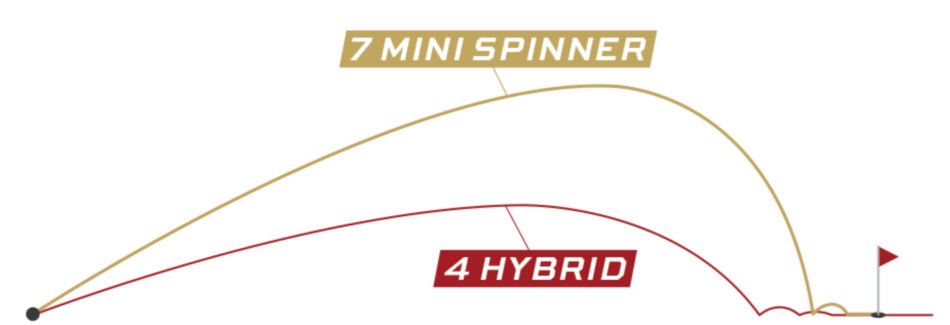
Nishimura called on Callaway’s Asia Tour division, saying she needed a fairway wood that not only got her to the green but also enabled her ball to hold it. Soon, she was at the Ely Callaway Performance Center (ECPC) in Carlsbad, CA, explaining her situation. The company got to work thinking that, because LPGA clubhead speeds/ballspeeds aren’t dissimilar to those of the average male golfer in the U.S. (the average driver ballspeed on the LPGA Tour is around 140 mph while the average driver ballspeed for a 10-handicap male golfer is about 138 mph – LPGA players’ smash factor is better, hence the slightly greater ballspeed) there would be a market for such a club among male golfers in America.
The club is modeled on an old Great Big Bertha fairway wood that Nishimura has played for many years…but with a few tweaks. Like the old GBB club, the new club has a slightly deeper face than Callaway’s current fairway woods, and there is significant camber in the leading edge.
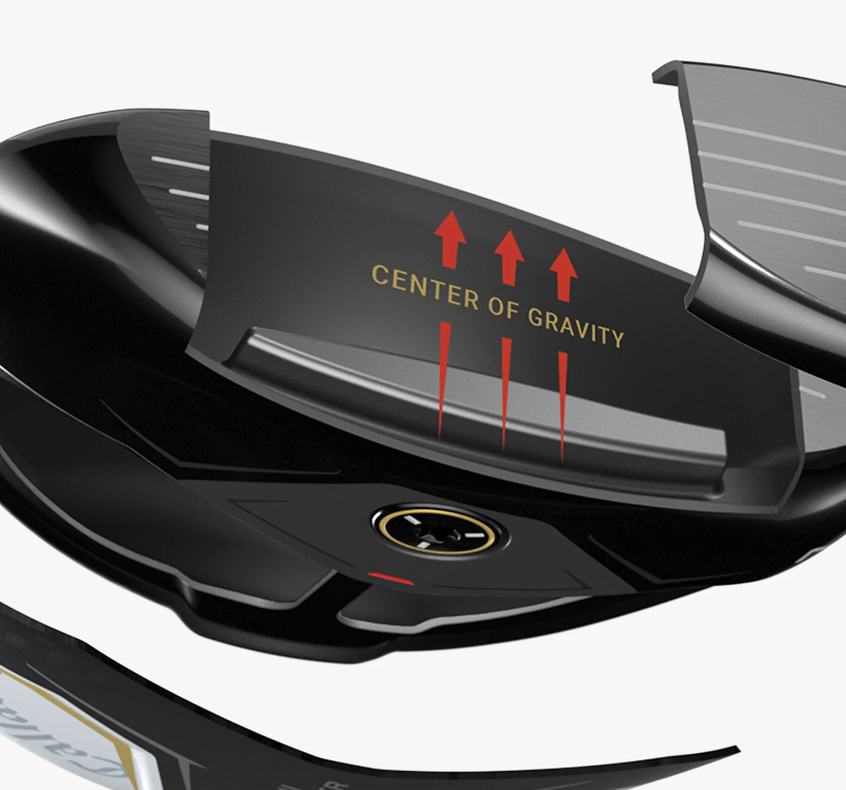
The major difference between Callaway’s current metalwoods (well, those of every company that makes multi-material clubs) and the new club, however, is that rather than using heavier material for the sole and lighter carbon composite for the crown which moves the Center of Gravity down a few millimeters, the materials actually trade places – a composite sole with a metal crown, thus raising the CG (in the 7 and 9-woods anyway. The 11-wood is so small and has so much loft the differences in weight between the two materials is negligible as would be any performance gains).
By raising the CG, you might lower a shot’s trajectory slightly – the loft on a 7,9, or 11-wood is going to create a relatively high launch, however – but the ball’s spin rate will increase significantly (up to 800 rpm more than with a Quantum 7-wood).
An AI-optimized face, one designed not to increase ball speed but create more consistent launch and spin, helps make this new club less about distance gains and more about tighter dispersion and better stopping power on the green. Also helping emphasize control are shorter shafts – 41½ inches for the 21-degree 7-wood, 41 inches for the 24-degree 9-wood, and 40½ inches for the 27-degree 11-wood. That’s three-quarters of an inch shorter than the equivalent Quantum fairway woods, which is a lot. The club’s slightly steeper lie angle will help you control the ball better, too, as you’ll be standing slightly closer to the ball.
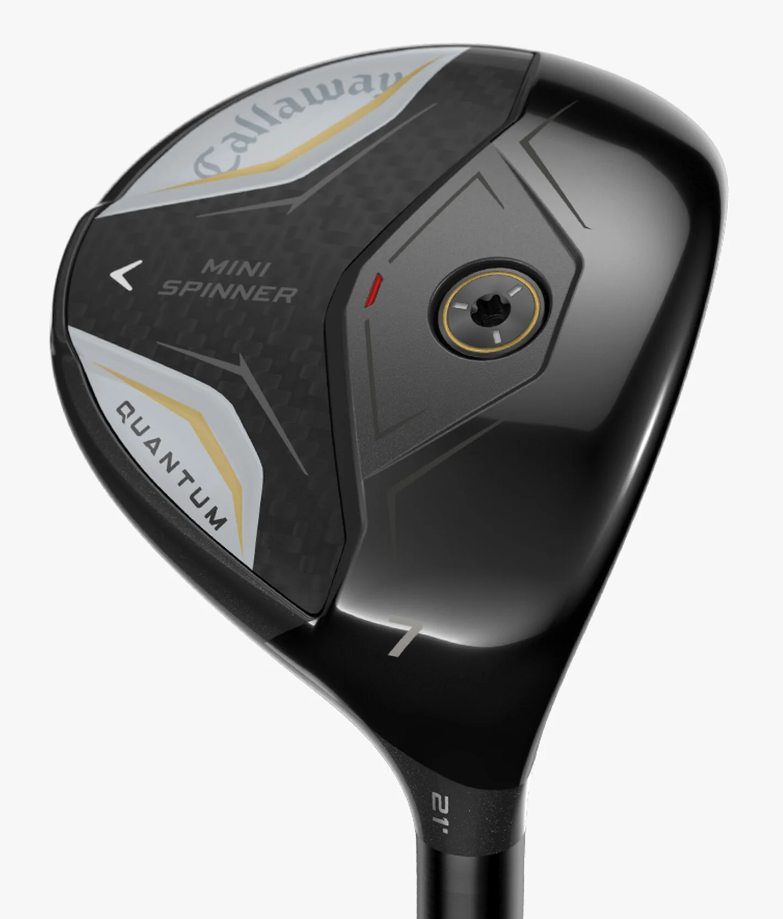
The Step Sole, meanwhile, is designed to prevent bouncing or digging, so with a deeper face and shorter shaft, the club is effective from virtually any lie.
Of course, with the addition of the Mini Spinner, which its maker likes to think of as a ‘scoring wood’, Callaway is now offering five alternatives for long/mid-irons or clubs in the 18̊ – 27̊ range, the other four being lofted woods, utility irons, the Apex UW, and a 4/5-hybrid. But whereas the other clubs all seek to give you a few extra yards, the Mini Spinner tries to minimize roll and prevent them – the ones that see your ball run off the back of the green, anyway.
The ‘Mini’ in Mini Spinner likely refers to shorter shafts rather than the potential size of the market. But who knows? The solution to Yuna Nishimura’s struggle to hold the green on par-5s with firm surfaces might be just the thing your game needs, too.
A word on adjustability. The Mini Spinner does not feature a hosel adapter. You might think a hosel adapter would help raise the CG, which is true. However, in Japan, where the club is already the best-selling fairway-wood on the market, adjustability is not so highly prized, so the club was first made with a fixed hosel. That may change in time, but it might not.
$380
Lofts – 7-wood 21̊, 9-wood 24̊, 11-wood 27̊
Shaft – Project X Denali Frost
Right-hand only
Pre-order at callawaygolf.com now. Available in stores August 14th.