Edens makes Mid-Am Final Eight again
Colorado players holding their own in 2026 USGA Mid-Am

By Tony Dear
Explaining the design of Callaway’s new Opus SP Wedge is easier with a little club–tech 101…
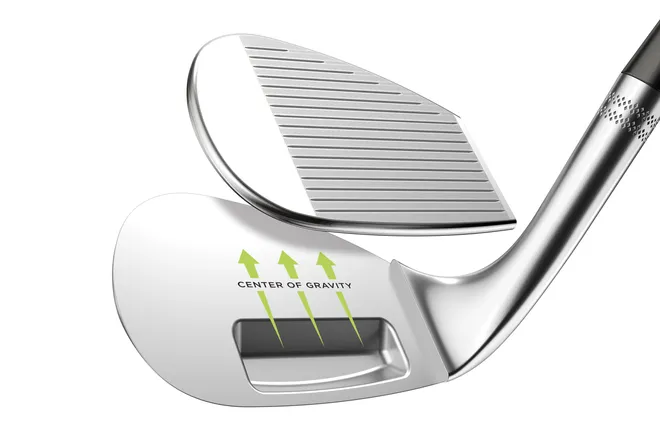
The game’s governing bodies need to monitor a golf club’s dimensions and appearance, which means manufacturers must be creative in devising ways to alter a club’s performance and appeal to specific types of players. One way to do this – something they have focused on for many years and become very adept at- is shifting weight around the clubhead to affect trajectory, shot shape, and MOI (forgiveness).
Because you’re standing farther from the ball and there’s less loft on the club, it’s more difficult to get the ball off the ground when hitting longer irons. Clubmakers, therefore, push weight toward the sole to position the Center of Gravity (CG) below the contact point, which helps get your shot airborne.
With shorter irons, however, there is more loft on the club, which sends the ball higher, quicker. Up in the air and without much forward momentum (less than with a straighter-face club anyway), the ball is at the mercy of the wind, and it doesn’t take a strong wind to alter the direction of a ‘floating’ golf ball, even slightly.
The ideal wedge, therefore, keeps the ball below the air/wind with a flatter trajectory, but still helps it grab, spin, and stop on the green (hopefully near the flag) with specially designed, aggressive grooves.
Callaway’s Opus wedge, introduced in summer 2024, was an attractive, teardrop-shaped club with a higher toe that the company’s stable of players certainly appreciated (Xander Schauffele won the PGA and Open Championships with them while Yuka Saso won the Women’s U.S. Open).
It focused mainly on generating maximum spin with “Spin Gen Face Technology” – a three-pronged system that 1. Placed grooves closer together, allowing for more of them (two more than Jaws, one more than CB) 2. Added angled mini-grooves between the larger grooves to generate more spin when you opened the face, and 3) Face-blasted the club with tiny quartz crystals to create a rougher surface that generated more friction/spin.
The Opus Platinum, which arrived shortly after the mother club, not only had the Spin Gen face but also a 17-gram strip of dense tungsten at the top of the clubhead to lower/flatten the trajectory (it is only available in higher-lofted wedges – 54˚ – 60˚). It also uses Metal-Injection Molding (MiM) to insert a blend of metals into the clubhead, which fine-tunes how the club feels and performs.
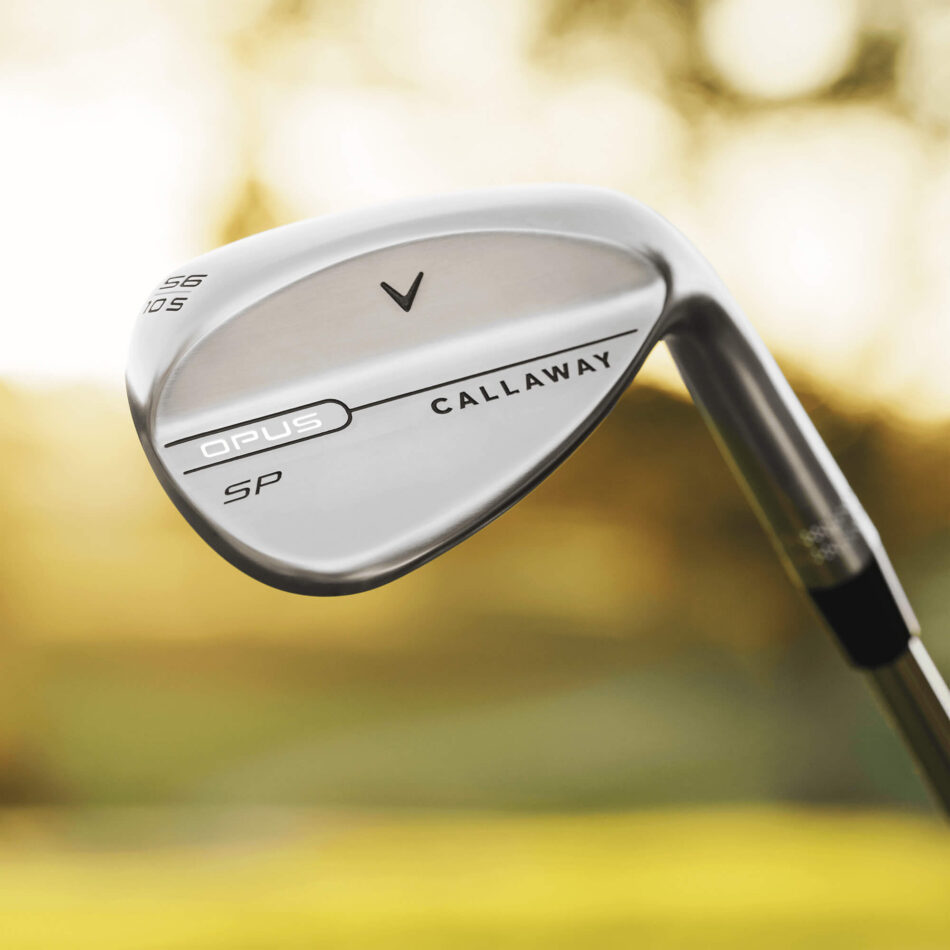
The recently-announced Opus SP Wedge (SP stands for Spin Pocket) features a two-piece construction – 1025 carbon–steel face and a cast 8620 steel body – and takes weight from the middle and lower sections of the clubhead to raise the club’s CG. It’s an innovative way of flattening the trajectory and helping you to spin/control the shot better.
The face benefits from second-generation Spin Gen, where grooves are placed even tighter together to help with consistency from the rough. A laser-etched face pattern beneath the surface plating ensures the surface is more durable than previously.
The Opus SP retains the original Opus’s shaping, though the lower-lofted clubs have been altered slightly to disguise the transition from short-iron to wedge. That, too, resonated with Callaway’s players – Shauffele, Jon Rahm, and Nicolai Højgaard putting them in the bag at the Memorial and Scottish Open.
The Opus SP will be available in five grinds – T (very shallow divot for precise shotmaking from tightturf – 6˚ of bounce); C (great versatility with a shallow divot – 8˚ of bounce); S (good for any situation; takes a deeper divot; ideal for players who prefer to keep the face square – 10/12˚ of bounce); W (a wide and forgiving sole that also takes a deep divot – 12/14˚ of bounce); and X (heel/toe, trailing edge relief;ideal for those with a steep angle of attack – 12˚ of bounce).
$200 per club (steel); $210 (graphite)
Lofts – 46˚ – 64˚ – (some grinds only available in specific lofts)
Shaft – True Temper Dynamic Gold S200 (steel); UST Mamiya Recoil Dart (graphite)
Finishes – Satin Chrome and QPQ Black
Right and left-hand (though left-hand options will be limited)
Availability – Online pre-sale begins August 22nd; in stores September 12th.
callawaygolf.com
Colorado AvidGolfer Magazine is the state’s leading resource for golf and the lifestyle that surrounds it, publishing eight issues annually and proudly delivering daily content via coloradoavidgolfer.com.