While they may be losing ground to more modern long-game clubs, plenty of players still choose to play hybrids. Titleist just introduced its latest models to the PGA Tour.
By Tony Dear
Most readers will be aware that high-lofted fairway woods are becoming increasingly popular on the world’s professional tours. Independent website WITBhub.com has 211 Tour bags in its database and shows 72 of them now have a 7- or 9-Wood. The most significant reason lofted fairway woods are becoming preferable to hybrids is that they are easier to launch high, fly a good 20% or so higher, and descend at a steeper angle, meaning shots hit with a 7/9-wood have a greater chance of holding a green. They also create a little more ball speed, are considered better out of rough, and in most cases have an MOI that’s about 300 g/cm² higher than a hybrid’s.
It’s not just lofted fairway woods that are taking up market share from hybrids, however. Utility irons are becoming similarly popular, with 60 of those 211 bags now holding at least one – Scottie Scheffler uses a 23-degree Srixon ZU85, while Collin Morikawa has a TaylorMade P-DHY in place of a 4-iron.
Just as lofted fairway woods have become more forgiving, so utility irons have become noticeably easier to hit with wider soles and lower CGs – a combination that makes them easier to launch than they once were. They also appeal to players who want to shape the ball and have it fly on a more piercing trajectory that creates a little more roll.
But while hybrids are definitely being squeezed out on the PGA Tour – only three wins in 2026 were recorded by players with at least one hybrid in their bag – they are still being used by roughly 20% of Tour players, and they came in pretty handy at a couple of big events this year. Cameron Young used a 20-degree Titleist GT1 in winning the Players Championship, and non-staffer Aaron Rai wielded a 24-degree GT2 to great effect at the PGA Championship. (An estimated 60% of amateur golfers still have at least one, with over a million golfers who play off 15 or higher continuing to use a hybrid).
Hybrids are one of the five equipment categories that Titleist leads on the PGA Tour (there are seven total), with 48% of those who carry a hybrid using a GT model.
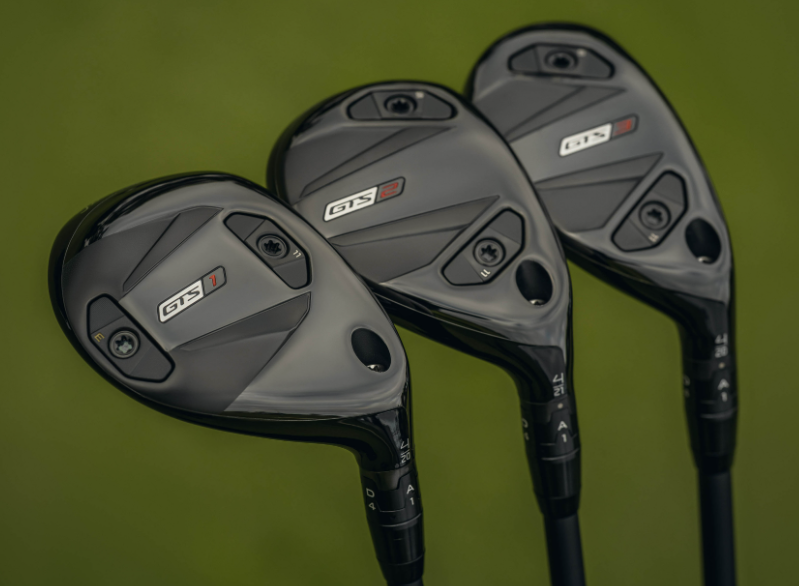
Last week, the company introduced three new hybrids – GTS1, GTS2, and GTS3 – to the Tour at the RSM Classic, and also at the LPGA Tour’s CME Group Tour Championship. Their appearance follows the phenomenally successful May launch of the GTS drivers and fairway woods, and while we don’t know exactly what technologies the hybrids possess, we can make some educated predictions from what we saw at the weekend and from images/info on the USGA’s conforming hybrids list where the clubs first appeared last week.
The GTS1 has the largest head of the three and features front and rear sole weights. The GTS2 and GTS3 have heel and toe weights. While the compact GTS3 will be available only in 18- and 20-degree models, the GTS2 and GTS1 will each come in four lofts. Though the GT hybrids offered impressive forgiveness and ball speed, the GTS is sure to improve on its predecessor, and launch and spin have also likely been optimized.
No retail release date has been announced yet, but one suspects they will arrive in the marketplace early in 2027.