I don’t know where to look. Yes, there’s a downhill par-4 unfurling itself right in front of me that should be the focus. But to my left, I can see at least 10 different greens. To my right, endless rows of apple orchards. Far below me? The mighty Columbia River. Beyond that, the ridgelines of various mountains stretch upward. And I’m supposed to concentrate on my score here? Yeah, right.
So goes a round on the new Scarecrow Course at Gamble Sands; those same things will distract anyone who plays here. The layout is another David McLay Kidd concoction (as is the original course that debuted here in 2014), but one that’s been deftly executed by his associate Nick Schaan. This is thrilling, infinity-edge golf at its finest, with the mesmerizing, panoramic scope of the landscape almost too much to digest in one visit.
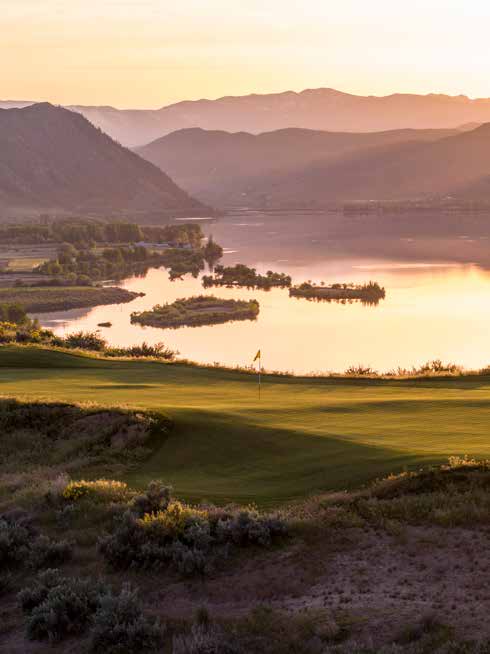
Scarecrow #9 // Photo Credit: Brian Oar
It’s all thanks to the Gebbers family, local Washington legends whose fruit-growing operation remains in full bloom these days. They have long been sending their apples (grab one in the golf shop), cherries (try the chocolate-covered ones), and other tasty fruits out to customers around the country and the world.
Then a whole new breed of customers started coming to them when McLay Kidd authored that fetching original Gamble Sands layout more than a decade ago. It was instantly recognized as a must-play that today sits at No. 14 and No. 24 respectively on Golf Magazine’s and Golfweek’s “Top 100 Best Courses You Can Play in the U.S.” rankings.
“At one point we were turning away golfers because tee times sold out,” said Blake Froling, general manager since 2021. “So people were calling here but then going to play somewhere else. That was the driver behind building the second course. That’s probably the hope for the next course, once we’re sold out at Scarecrow, too.” Bet anyone your green fee (that’s $215–$255 for either course between April 18 and October 5 next year) that will definitely happen.
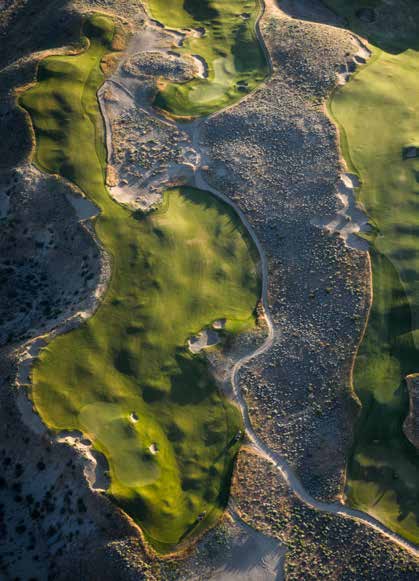
Scarecrow #18 // Photo Credit: Patrick Koenig
First, that course name. This was not some piece of Midwest farmland. Instead, it was sand- and sagebrush-laden property on a bluff high above the Columbia River, all a 2.5-hour drive from Spokane (where Southwest and United fly direct from Denver, although more direct flights go into Seattle; from there it’s a 4-hour journey). But a part of it had been used to grow corn, hence the name of that area’s former protector. Then again, another portion was once used as a reindeer farm, so it could have been called Reindeer Run. Alas, not to be.
Scarecrow is a different experience than its older sibling, thanks largely to topography. As Schaan has said, “This part of the site has higher, peakier spots that were more akin to classic sand-dune, sandhills-type blowouts — and we exposed some of those, we preserved some of those. And the piece of land is just smaller. If you draw a circle around the first course, it sits on 350–500 acres depending on how you draw it. This new course sits on about 300 acres, and so it’s a lot more compact, things are a bit closer together. But the fairways are still wide — in some cases, they are even wider.”
Width is less important on the opening hole than staying right of the fairway bunker. Do that and a steep downhill will propel your ball toward the green. Not dissimilar are the seventh and the 14th, the latter with a ski-slope fairway severe enough that you could use a putter for your approach. The real stars are the ninth, 10th, and 11th, two par-3s backdropped by the Columbia River and bracketing a downhill par-4 with orchard and water views. The closer is a drivable par-4 (if you play the right tee), rare for an 18th hole, albeit one requiring a bold carry over a chasm and the avoidance of greenside bunkers.
Like all siblings, the two courses have their differences. “When the idea of a more challenging second course was presented, I wasn’t a big fan of that, just because I love how much fun people have on Gamble Sands,” explained Froling. “I think you need to be a bit more targeted on choosing the right fairway side on Scarecrow for a better angle to the hole. There are often blind shots if you’re not, so that’s a subtle difference. There are the same big rolling hillsides and slopes as there are on Gamble Sands, but on Scarecrow there are bunkers in those slopes, so you’ve got to be more targeted. The topography comes with more elevation changes on Scarecrow. It’s all enough to never make you feel like you are playing the same course.”
Gamble Sands Clubhouse // Photo Credit: Tom Mackin
I played both a day apart this summer, and if forced to choose, would play seven of 10 rounds on Scarecrow. It’s just more fun and manageable overall, but you really can’t go wrong with either choice. “The reason why Gamble Sands was successful is that you want to go play it again right away,” said Froling. “When you get done playing 18 there, you know there are things you would do differently. Same goes for Scarecrow.”
Speaking of fun, you must play Quicksands ($60–$75), an engaging gathering of 14 par-3 holes a quick stroll away from the clubhouse. A blast in all respects, especially with a Huckleberry Transfusion in hand for fuel. Nightcaps with glow balls on the Cascade putting course, steps away from the main lodge rooms (an original 37 there have been augmented with another 40 opened this summer overlooking the Scarecrow course), often serve as the finishing touch on most days here.
Golf season in these parts usually runs from early April to mid-October, with September a particular standout for both course conditions and less wind than usual. “The beauty of this place is you never have to cancel your trip due to weather here,” notes Froling. “You’re not going to have rain forecast for five days. It might be warm, but that’s the only risk you are taking.”
Froling’s days will soon be filled with even more golfers flocking to this remote part of Washington now that the place meets Mike Keiser’s standards (the Bandon Dunes founder has famously said, “One course is a curiosity. Two are a destination”).
But when Froling does get the chance to play, there’s one particular spot he relishes the most. “To be playing 17 green on Gamble Sands at sunset is my favorite place to be,” he says. “The sunsets from there are silly. You’re seeing over to Scarecrow, to the 18th fairway on Gamble, there’s a bunch of holes behind you, and there’s the view of the Columbia River and beyond. It’s a magical spot if you can time it right.”
Want to increase golf swing speed and hit longer drives? Learn two simple ways to add clubhead speed, improve hip rotation, and create more distance off the tee.
The Japanese brand that’s part of Dunlop Sports appears to be disrupting conventional launch dates with the September/October releases of its latest equipment