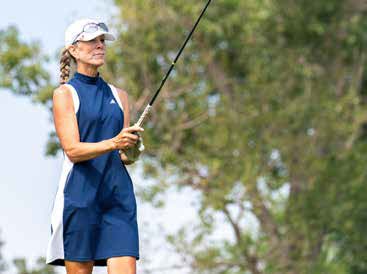
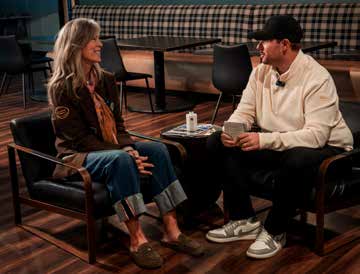
Kristine Franklin, one of Colorado’s most-successful amateur players, on what drives her to succeed.
By Michael Colander
(MC) Talk us through your year in golf. You won Senior Player of the Year again, and you won some big tournaments for the CGA again. What were some of your best moments in 2025 on the course?
(KF) I’d say winning the match play was big, especially with so many players coming in from out of state, that made it a really good win. The stroke play was also a great victory. It’s fun to play, but when you’re competing against your friends, it can make things a little tricky. We always have a great time out there, and I really enjoyed that. And qualifying for the Senior Women’s U.S. Open is always such a treat, just to have the chance to go play. I didn’t play as well as I wanted at the event, but that’s alright.
(MC) Talk us through the difference between the CGA (Colorado Golf Association) match play or stroke play, and then the US Senior Women’s Open. What are the differences between a state-level event and an international-level event.
(KF) They definitely are different experiences, and different vibes. You have to prepare yourself emotionally for the USGA events. I’ve obviously had more experience playing in CGA events rather than USGA events, but I think it’s how you prepare mentally for those versus a CGA event. The more I play in the bigger USGA events, the little more confidence I get. So, I’m really looking forward to 2026.
(MC) Talking about preparation, what is the difference of how you prepare for match play versus stroke play?
(KF) I don’t know that it’s a big difference for me. It really comes down to getting my game in shape: my touch, chipping, and putting, and hoping my long game is there. In match play, it’s about understanding the dynamics: your opponent might be out of the hole, but you never assume anything. It becomes more of a mental preparation, playing the course while staying aware of what your opponent is doing, so there’s a little more strategy and movement going on.
(MC) What does it take to go back-to-back as the Colorado Golf Association Women’s Senior Player of the Year?
(KF) It’s always a real honor to get that because it’s not just playing, it’s also how they look at you as a person out there and how you carry yourself. So, that to me almost makes me feel even more proud. But, going back-to-back, the more you think about it, it starts to get in your head. (Laughs) I’d rather not think about it. But no, it’s a true honor. I appreciate it.
Photo Credit // Colorado Golf Association
(MC) You’ve had a lot of accolades, and a lot of accomplishments on the golf course. What still gives you goosebumps when you look back at kind of what you’ve done on the course?
(KF) Gosh, I’d say it was probably just starting to play again. My dad had passed away when I picked the game back up as an amateur, and I really wanted to bring home a trophy for him. The first one was the CJA Match Play, which I lost in extra holes, and that was okay. But I was able to win the stroke play and bring him a trophy. They’ll always be your parents.
That win made me feel like a kid again. Now it’s about continuing to play and setting goals for yourself. For me, it’s never been about who to beat, but about how to challenge myself—how I approach things, whether I can do this, and how I set goals without placing too many expectations on myself. That’s probably what coming back was really about: being able to do something for my dad, and now, doing something for myself.
(MC) Golf is one of those things, right? It’s not a team sport, but there are so many people in your corner that you have to have when you’re playing at a level, like a professional level or just even in a competitive level, that it is a team sport.
(KF) When I first came back to competitive play, it’s been about 23 years now, I returned as an amateur and qualified for the Senior Amateur. I think I was in third place after the first round, and I started getting all these texts saying, ‘Hey, great job, Kris.’ I remember asking my husband, ‘How do they even know this?’ And he said, ‘It’s on the internet. They can see it.’ I was like, ‘Oh my gosh,’ because back then, it wasn’t like that. That’s when it hit me that people were watching me, they could actually see what I was doing. And that became one of the hardest parts mentally. When I played in the Senior U.S. Open and made a birdie, I’d think, ‘Everybody’s watching, they’re happy.’ But then I’d make a bogey and think, ‘Oh no, they’re watching that too.’ And I realized, Kris, you have to get over this mentally.
But then I started to look at it differently. You kind of become like a racehorse, and people get to be part of it—it becomes your team. And I thought, how neat is that? They’re following you because they care, and they’re only hoping for good things. When I saw it that way, it gave me even more reason to play, to try and bring them a little joy or something fun to watch. And that’s when I realized it’s okay that they’re watching and wishing you the best.
(MC) You’ve seen golf change a lot. Where do you see the women’s game going?
(KF) When I first started playing, it was such a man’s sport. I was usually the only girl out at Flatirons Golf Course—that’s where I grew up. I tagged along with my brother, and my dad would say, ‘Here’s the fairway, follow along.’ That’s how it all started.
I grew up playing with Janet Moore—now Janet Ruma—and that was really the beginning of seeing more women entering the game. What excites me most now is looking at college golf and seeing just how strong and talented the women are. They are so good. Sometimes I think, if I won the lottery, I’d endow the Symetra Tour just to give them more opportunities to play. People don’t always realize how good these players are, their power, the purity of their swings – it’s so much fun to watch the women’s game grow into what it is today. And especially in Colorado, we’re right at the forefront. We have the Annika event at Todd Creek, the Colorado Women’s Open is a big one, and it’s exciting to see the state leading the way.
I love the Colorado Open because of the prize money they offer. People don’t realize that even just making the cut can be a lifeline for these players—it helps them keep going, keep traveling, and keep chasing the dream. There’s still not enough to fully sustain them, but opportunities like that make a real difference.
(MC) What advice do you have for those players? The ones that are the high schoolers that are coming up or the junior player or someone on the Anika Tour that’s grinding, trying to go pro.
(KF) I would say, celebrate what you do well. We’re always looking at what we’re not doing and trying to pick that apart. But what about what you’re doing right?
And don’t forget the mental side. Visualize what you want to do and what you see happening and then follow that while staying positive. It’s not always about being happy—it’s about staying focused. You have a job to do, and you can’t let your emotions swing you up and down or start judging yourself. It’s just let’s get the job done and prepare. The guys on tour have their whole game plan ready, and you don’t even realize it. That’s something young golfers coming up need to learn—course management. We didn’t have that when I was starting out. I was fortunate to learn from my father, but even more from my husband. What he has taught me is unbelievable.
Photo Credit // Colorado AvidGolfer
(MC) And your husband’s your caddy. Talk about that relationship a little bit.
(KF) It’s so fun because he wants it for me so badly, and you can feel that. When I was younger, I had a really solid game because I was playing day in and day out, and I don’t do that as much anymore. So when I wasn’t playing well, I could say, ‘Come on, let’s get this going.’
I remember one time we were out there and he was like, ‘Come on, you’ve got to fight, you’ve got to fight.’ And I was like, ‘The car’s not running well—there’s only so much I can step on the gas.’ It was during one of the qualifying rounds, and I said, ‘Brent, please don’t tell me to grind or that I’ve got this. Just be gentle—be my cheerleader.’
I hit the shot and it was just ugly. And he looks at me and goes, ‘You’re pretty.’
Perfect. That’s exactly it. He made me laugh, and we had a great time.
And anytime it’s something big, like the U.S. Open and we’re going to San Diego, he’s like, ‘Who wants to go to San Diego anyway?’ It’s those moments that are so great, and I’m learning to really treasure them.
(MC) Do you have any golf courses on your bucket list that you have not gotten to play in Colorado or in, in the country or the world?
(KF) Just anywhere to go play with my boys. I would love to take them to Europe just for that experience. So that would be on my bucket list.
Colorado AvidGolfer Magazine is the state’s leading resource for golf and the lifestyle that surrounds it, publishing eight issues annually and proudly delivering daily content via coloradoavidgolfer.com.
Want to increase golf swing speed and hit longer drives? Learn two simple ways to add clubhead speed, improve hip rotation, and create more distance off the tee.
The Japanese brand that’s part of Dunlop Sports appears to be disrupting conventional launch dates with the September/October releases of its latest equipment