It’s not just about negotiating the putting surfaces, but how you get on them. Irwin points out that at The Broadmoor, like at Augusta National, choosing the right line on approach shots is imperative, which makes positioning your drive that much more critical.
Toms agrees. He’s from Louisiana, but he also knows something about mountain golf, having won The International at Castle Pines Golf Club in 1999. Whereas that event’s Modified Stableford scoring system rewarded aggressive play, at The Broadmoor, he says, “You have to play the course to make pars, which means keeping it in the fair- way off the tee, even if you have to use clubs other than your driver, because the pitch of the land off the mountain can carry a shot with some chase on it from the fairway into the rough and out of posi- tion.”
Over the four days of the U.S. Senior Open, Toms repeatedly put himself in good positions — and when he didn’t, he relied on sound course management and gutsy putting, tallying 51 pars, 12 birdies, nine bogeys and nothing higher.
Toms showed his grit on Sunday’s back nine — a par-34 gauntlet measuring 3,735 yards (220 more than the par-36 front nine) and home to eight of the tournament’s 10 hardest holes in terms of stroke average. Paired with leader Jerry Kelly in the final group, he demonstrated an Irwin-like resilience and ability to close.
Trailing Kelly by one at the turn, both players parred the difficult downhill left-dogleg 10th. After Kelly bogeyed the 11th and 12th, Toms did the same on the 13th, dropping the pair into an overall tie with Miguel Angel Jiménez and Tim Petrovic at 2-under.
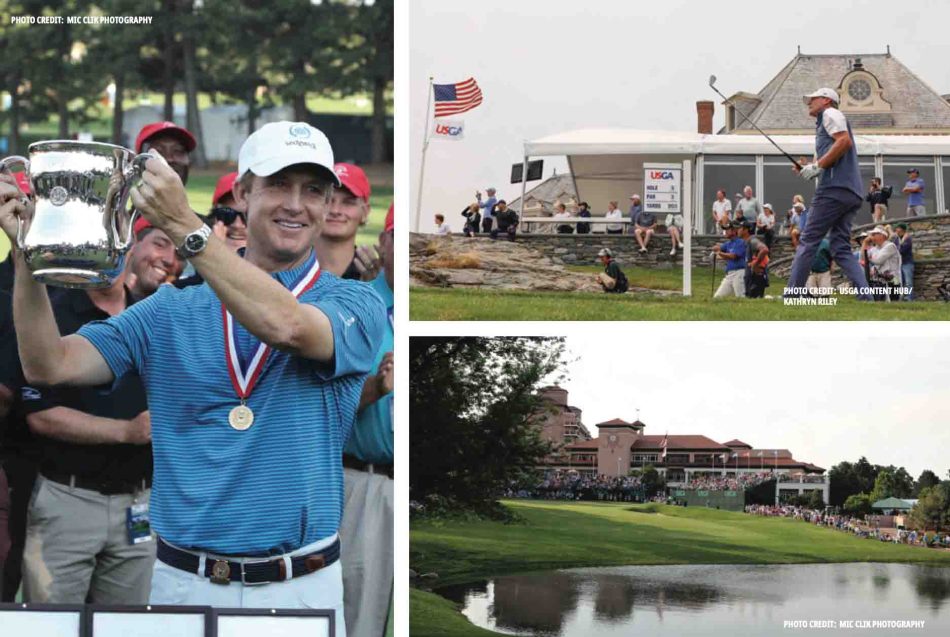
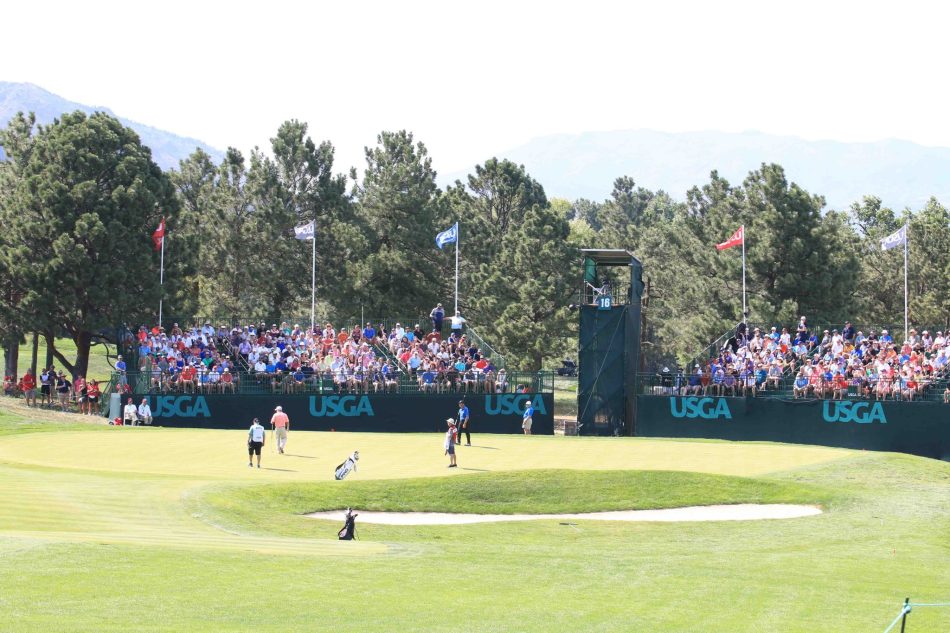
As Kelly made six consecutive pars to finish, Toms made three of the most critical of the 26 putts he’d stroke on Sunday. On the par-3 16th, he drained a 16-foot birdie to take the lead. On the 532-yard par-4 17th, he recovered from a poor tee shot into the rough and saved par with a brilliant 19-foot downhill putt. Needing two putts to clinch victory on the iconic 420-yard closing hole, Toms slid a 17-footer four feet past the hole. He then jarred the knee-knocking comebacker for par, clinching par and possession of the Francis D. Ouimet Memorial Trophy.
After missing the cut, Hale Irwin watched Toms win from outside the ropes. It wouldn’t shock him to see Toms repeat. “He has what it takes to get to the 72nd hole,” he says now. “But I wouldn’t be at all surprised to see Steven Alker at the top, or another Steve — Steve Stricker. Talk about a guy who can putt! And of course, you can never count out Jiménez — there’s no ‘back-off’ in him.”
The 2018 U.S. Senior Open drew a crowd of 134,500, including 28,700 fans on Saturday and 31,000 on Sunday. It marked the most to attend the event since 157,000 people descended on Omaha Country Club in 2013. Hotels in the Springs—other than the sold-out Broadmoor and Cheyenne Mountain Lodge—enjoyed their highest occupancy rates (90.7 percent) since 1996, delivering $30 million to the local economy. “It had a huge impact on the community,” said Doug Price, CEO of the Colorado Springs Convention and Visitors Bureau. “We are thrilled the tournament is coming back.”