Edens makes Mid-Am Final Eight again
Colorado players holding their own in 2026 USGA Mid-Am

In the incredibly short span of fifteen years, McLaren has become the truest rival to Ferrari in the building of exotic sports cars that can satisfy the most discerning of drivers.
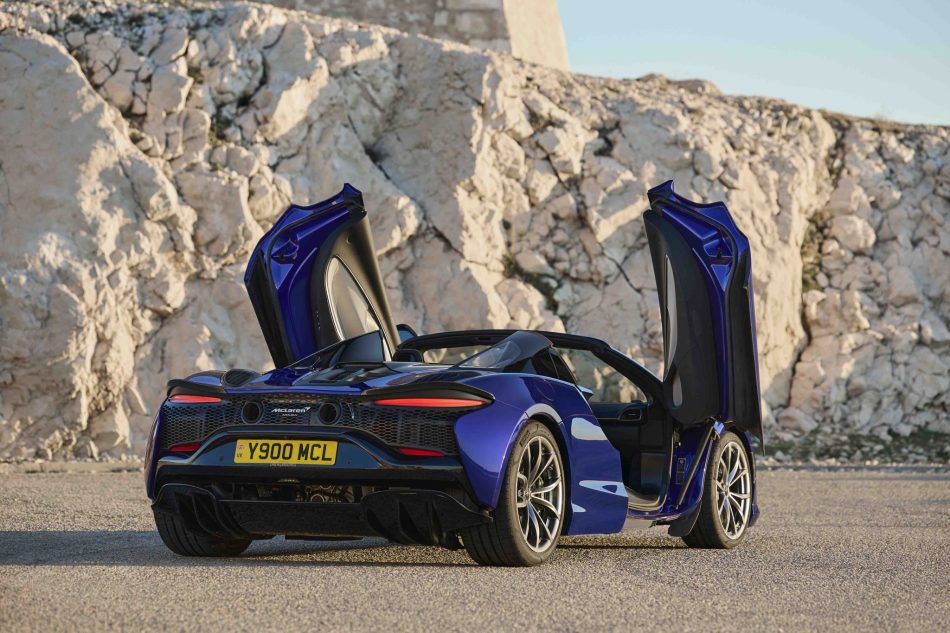
This is down to the same blistering pace of iteration and improvement that has allowed the company to rack up the second-highest tally of wins in Formula 1 history. With the Artura Spider, the company has also illustrated the ability to broaden its portfolio to include a more refined, grand touring-style machine that is still a 100-proof, head-banging hypercar.
It’s got most of the daily usability of something like a Porsche 911, with the jaw-dropping theater of the McLaren 720, 765LT and 750 models. The Spider’s carbon fiber core requires no reinforcements, meaning it only weighs 136 pounds more than the coup and less than 3,500 all-in. This enables the Artura to head-butt 0-60 mph in only 2.6 seconds, and more impressively top the ton (as the Brits call 100mph) in only 5.5.
There’s even a burnout feature, which goes by the clunky name of Spinning Wheel Pull-Away mode.
There’s certainly nothing clunky about how this plugin hybrid powertrain operates. This is the first Macca street car without an eight or 12 cylinder; in its place is a 3-liter V6 hooked to an 8-speed twin-clutch gearbox whose transmission bellhousing encloses a 94-hp electric motor.
Electrons flow to it from a 7.4-kWh battery pack, which can be plugged in or recharged while driving. Combined output is 690 horses and 531-lb-ft.
Since the electric motor produces max torque at zero RPM, the Artura has a very different character at step-off from previous company machinery. In E-mode, the McLaren glides along in the almost-silent manner of pure EVs; toggle the satisfyingly tactile flip selector up through Comfort to Sport or Track and its demeanor changes from boulevardier to race car without any of the dubious programming affectations most companies use.
There’s a separate flipper on the other side of the Artura instrument binnacle—which moves with the steering wheel so the gauges are always in sight—to dial the adjustable dampers to road conditions. In their softer setting, these cunningly programmed shocks allow the McLaren to deftly parry almost all the jabs dealt by our atrocious roads. Combined with excellent suppression of road and wind noise, the Spider makes cruising a refined affair.
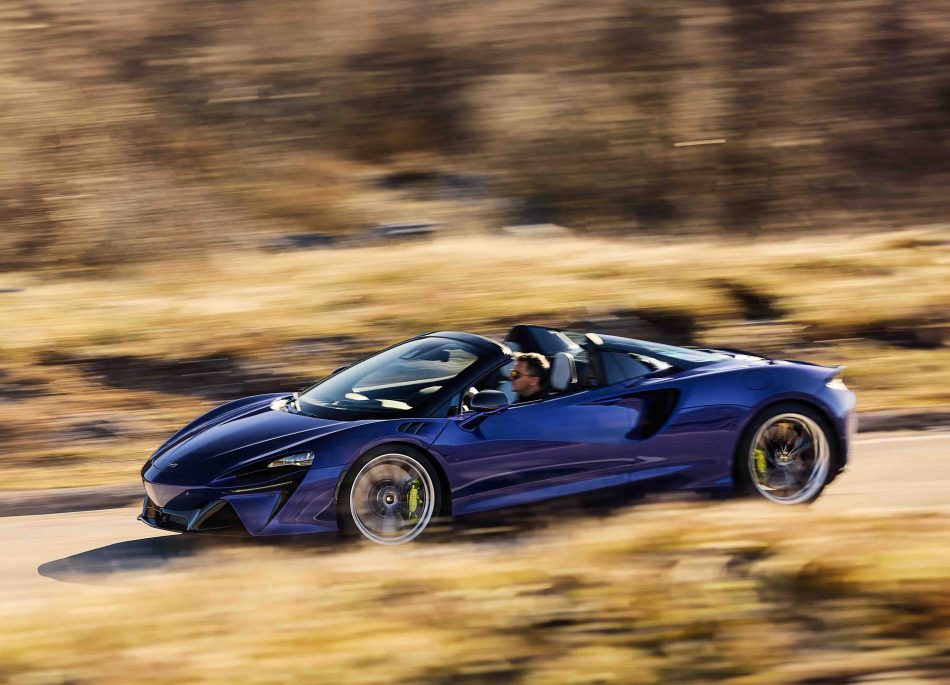
Dial things up to 11 and it moves with the precision and reflexes of a trackday special. The steering is a real ally here, being one of the only hydraulic setups still in production; the level of feedback and feel are well beyond almost every other car made.
The twin-turbo V6 has an 8200 RPM redline, with a burst of extra shove as one nears the redline that keeps the Artura from being as one-dimensional as a pure EV. It even sounds good, something that one could not always say about previous McLarens’ V8s. Braking is as stout as the shove, with the carbon discs working conventionally (unlike most plugin hybrids, which also use them to recharge the battery) with nigh-on-perfect feel and a firm pedal that responds to pressure more than travel.
The Spider switches from closed coupe to droptop in only 11 seconds and the rear glass can be raised or lowered to allow just the right amount of sound and breeze in.
The cockpit itself is a pleasing update on previous McLarens, with excellent quality, intuitive interfaces, logical controls and all the mod cons owners will demand in today’s choked-off driving environment, such as adaptive cruise control, a stunningly accurate B&W sound system and Apple CarPlay (but no Android Auto). There are two styles of seats on offer; sadly, the more supportive Clubsports seats don’t offer heating. At least the front axle lift control is now easy to activate under duress, helping save all those expensive carbon fiber bits from grinding themselves off on driveway entrances or speed bumps.
The Artura, whether in coupe or powered-hardtop Spider, represents a new chapter in the storied company’s history, combining the refined ride of a Bentley, the ease of use of a 911 Turbo S and the hybridized swagger of a Ferrari 296.
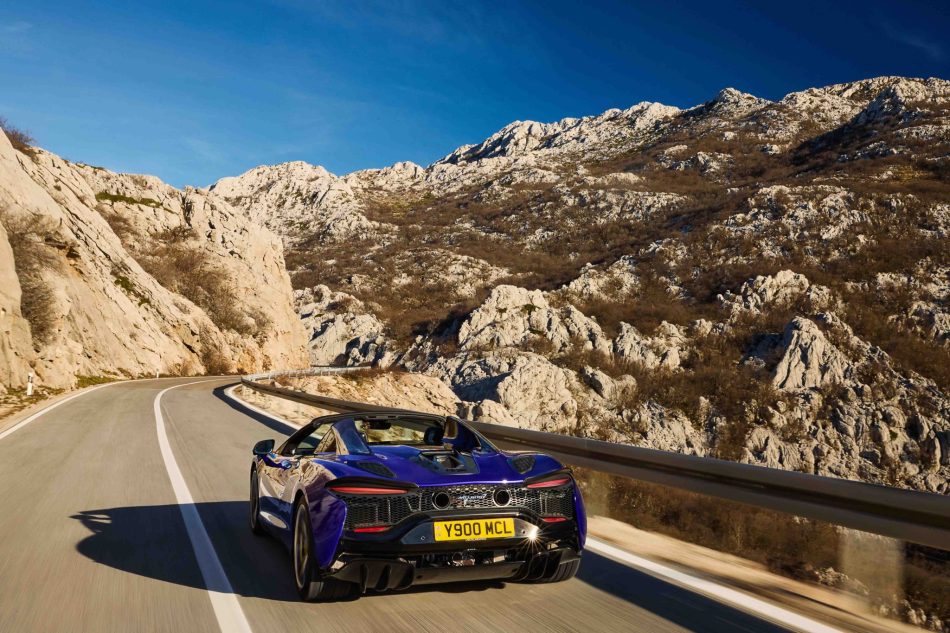
While the Brits charge a hefty premium for the open-air experience, the Spider remains comparatively good value, being priced between the Porsche and the half-mill Ferrari. It’s the young company in top form as well as one of the most compelling cars there is, full stop.
EPA Ratings: 45MPGe; 19MPG
0-60mph: 2.6sec
Price as tested: $360,008
Rating: 5 Stars