The tradition of sand-green is hanging on in Colorado’s eastern plains
By Jim Bebbington
Do you know how hard it is to hit the ball out of bounds at the Hugo Golf Club – one of Colorado’s few remaining sand-green golf courses?
On nearly every generous fairway it seems as though you have everything available to you – Nebraska to the north and New Mexico to the south.
And yet here I was, poking along a brush line on the northern edge of the property looking for my ball.
It turns out that sand-green golf isn’t all that different from green-green golf.
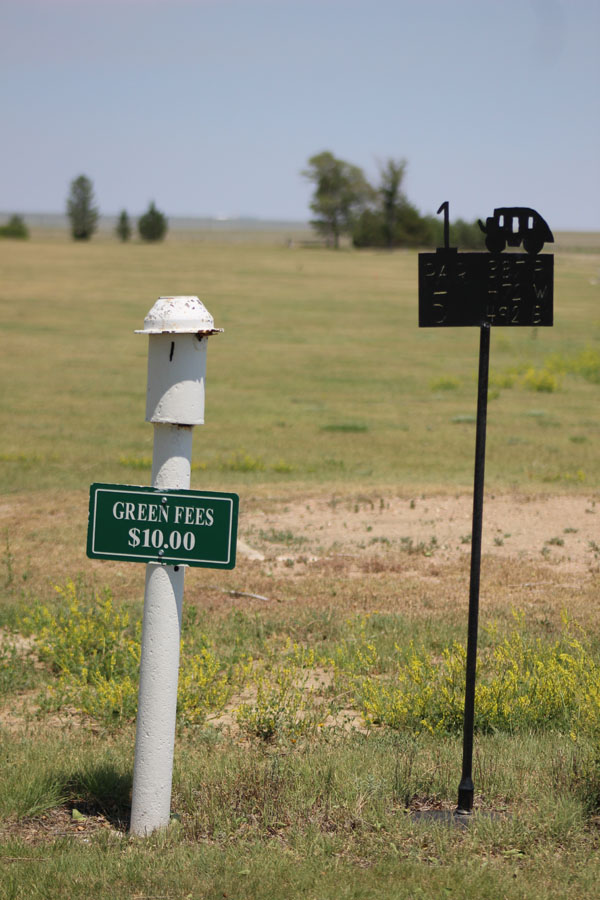
Hugo Golf Club honor box, where visitors pay their $10 and tee off.
Sand greens are the original surface for many courses beginning in the 1800s in the U.S., before modern irrigation practices allowed for grass to take over.
Remarkably, the famous Pinehurst No. 2 course – designed by Donald Ross, host of the 2024 U.S. Open – had sand and clay greens for the first 20 years of its existence. Even after Ross figured out how to grow grass and developed his signature greens-as-the-defense-of-the-course philosophy, he argued for Pinehurst No. 2 to retain its original sand greens. The course finally converted over its last sand green to grass in 1935.
Sand green golf courses flourished on the plain states and in Canada. Today there are an estimated 100 such courses still in operation. Most are 9 hole, regulation length courses.
Throughout eastern Colorado several small 9-hole tracts were built in small farm communities over the decades. Nearly all started out as sand-green courses but most converted to grass – watering the greens alone even if the fairways remained prairie grass.
The Hugo Golf Club in Lincoln County, about 100 miles east of Denver, is one of the few remaining ways to experience this old-school type of game.
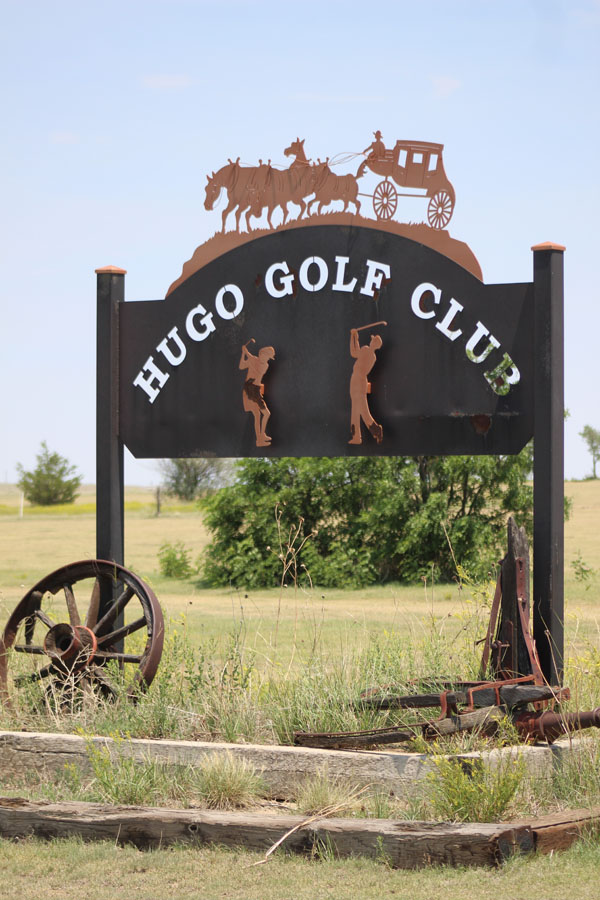
Hugo Golf Club
On a Tuesday this summer the course was not only no- waiting, it was no people. The parking lot stood empty and no one was in sight. A small honor-box by the first tee has a small slit in it with a sign – “greens fees $10”.
The course is maintained by local residents and is clearly a labor of love. The fairways are short-cropped prairie grass and the mower deck – pulled by a tractor – is parked outside the clubhouse. The course had tee boxes but the relentless winds on the eastern plains eventually wore them down so much it became easier to place the tee markers just on the flat fairway grass.
The course is par 36 9-holes that runs 3,080 yards from the back tees, with a 231-yard par 3 No. 8 hole that is legitimately one of the hardest holes around.
But it is the greens which make the course special.
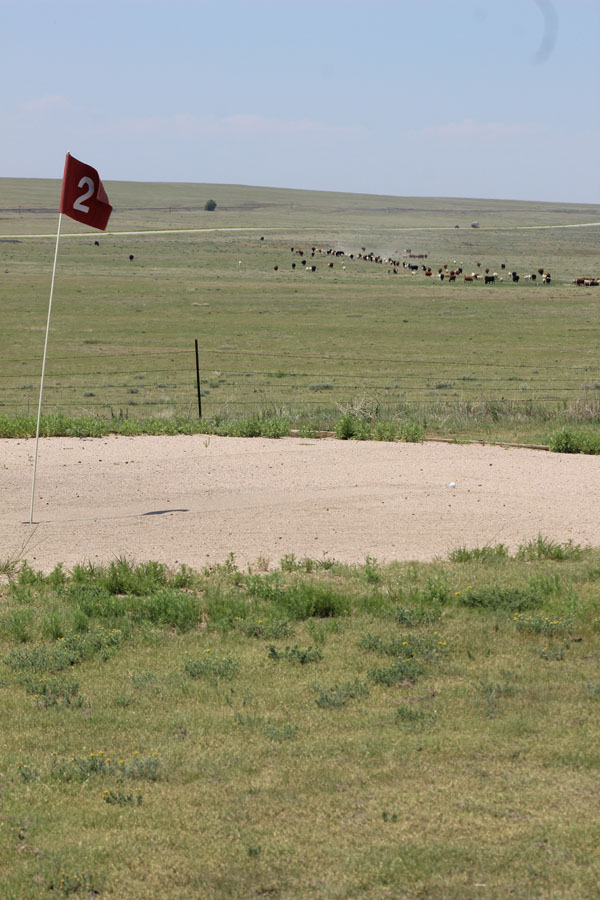
The sand is essentially Colorado prairie sand-dune sand – a mixture of grain sizes and small pebbles. All of the green shapes are basic circles and flat to avoid the sand washing off of slopes during the rare rainstorms. Cups are placed dead center, and flags are at times left out of the cup and lying on the sand in order to prevent the flag sticks from snapping in the sharp winds.
Beside every green are two rakes. The first can be used to smooth a path between a ball and the cup. The second is wider and can be used to drag away the footprints behind the last player off the green, leaving the sand ready for the next player.
Sand greens provide a unique opportunity for players who do not typically have much spin on the ball. Bring a shot into any green from up high and it is likely to land with a thud and roll only a few feet away. Pin-hunting is the way.
But the putts themselves are very hard to gauge. A player can over-hit a putt, but it’s not easy. Putts given a little more mustard than on a grass green will make it possibly only half-way to the hole. Players have to absolutely whack it to get a 10 to 15-foot putt close.
And if a putt hits a larger-than-typical pebble along the way it is anybody’s guess where it will bounce.
The second green, and neighboring steer, at Hugo Golf Club
Cam Crabtree, a PGA teaching professional at CommonGround Golf Course in Aurora who has a popular social media channel in which he is playing every Colorado golf course, played Hugo Golf Club early on in his odyssey.
“What’s special about them is they’re historic,” Crabtree said. “At some point it was the closest (golf) for like 100 miles. It’s cool to make the trip and it’s unique because it’s something you may never do again.”
Crabtree said he quickly decided to miss each green on purpose and chip from off the green rather than try to sink long putts.
“You can tell the communities that maintain these courses take them seriously,” he said. “ It’s golf for that community. That’s what’s so cool.”
The Baca County government website touts its Springfield Golf Course. “This is a 9 hole course with sand greens, golf cart rental is not available. No need for a tee time, just arrive and play.”
At Hugo Golf Club on a Tuesday in June there were no other players on site into the afternoon. Weekends the place livens up, with some local residents storing their own golf carts and clubs on-site and using the club as an easy-to-get-to home away from home.
Springfield Golf Course – 24933 Hwy 160, Springfield
Hugo Golf Club – 44161 County Highway 109, Hugo
Mountain Meadows Golf Course – Between Dowdy Lake Road and Bogie Avenue, Red Feather Lakes
Colorado AvidGolfer Magazine is the state’s leading resource for golf and the lifestyle that surrounds it, publishing eight issues annually and proudly delivering daily content via coloradoavidgolfer.com.
The tradition of sand-green is hanging on in Colorado’s eastern plains By Jim Bebbington Do you know how hard it is to hit the ball out of bounds at the Hugo Golf Club – one of Colorado’s few remaining sand-green golf courses? On nearly every generous fairway it seems as though you have everything available