The Colorado golf industry bands together every spring to advocate for a slate of laws
What do a bunch of Colorado golf industry leaders talk about when they get together?
Well, if it was on a certain day this past April at the Colorado statehouse, the answer is: taxes and water.
The golf community is made up of many different entities—course owners, players, organizations, and trade associations. But every year, a coalition of them comes together for a day at the Colorado Statehouse to make sure they are recognized as the multi-million-dollar, job-producing industry they are in Colorado.
If one were to take into account the value of the land that courses sit upon, it becomes more like a multi-billion-dollar industry.
“The coalition, which didn’t exist 20 years ago, has now coalesced and we have our act together,” said Ed Mate, CEO of the Colorado Golf Association.
The lobbying effort happens every year, but this year it had two main concerns. In one, they wanted to discuss a specific bill under consideration that had golf course owners worried. They also aimed to continue educating legislators about how the industry is conserving water.
House Bill 26-1119 is currently under consideration. If passed, it would give local communities the option to tax vacant land at a higher rate.
Legislators say the bill is intended to incentivize development in areas lacking housing by discouraging landowners from holding undeveloped property.
“Split-rate property taxation… provides economic incentives for productive investment… while disincentivizing land speculation,” the bill’s preamble states.
The concern from golf course owners is that industries relying on large open spaces—like farming, ranching, mining, and oil and gas—would be exempt, while golf courses would not, despite being fully developed properties.
“After hours of testimony and questioning, the bill was postponed indefinitely on an 8-3 vote,” said Rachel Carter of the National Golf Course Owners Association.
Several golf courses engaged with the issue, sending letters to representatives in opposition. Carter described it as a strong example of the industry speaking with “one voice.”
Beyond legislation, the coalition also focused heavily on water usage—an ongoing concern in Colorado.
With drought conditions persisting, golf course operators are working to ensure their conservation efforts are recognized and understood.
“Our bigger concern is water and the macro view that ‘Why are the golf courses green?’” Mate said.
Data shared by the coalition shows that only 1.4 percent of Colorado courses rely on municipal water systems. Instead, 54 percent use water from ponds and lakes, and 27 percent use reclaimed water from local systems.
The group also highlighted that golf courses help cool surrounding neighborhoods during hot summer months, offering environmental benefits compared to paved developments.
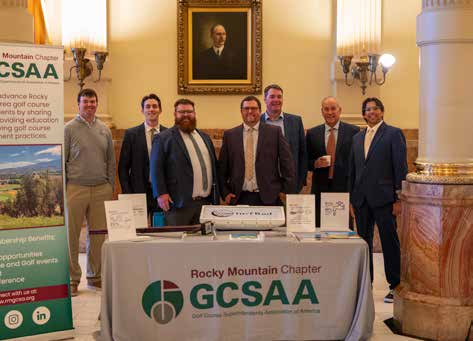
The coalition returns every spring for Colorado State Golf Day.
While conversations often focus on policy, industry leaders say the broader goal is relationship-building. Many lawmakers may play golf recreationally, but few fully understand the industry’s economic scale or environmental efforts.
Golf leaders view the annual visit as an opportunity to reshape perceptions before misconceptions turn into policy.
That message is becoming increasingly important as Colorado balances population growth, water conservation, and housing demand. Golf courses are often part of broader land-use discussions, even though they function as green spaces, wildlife corridors, and recreation hubs.
Industry representatives also emphasized that modern golf courses operate far differently than they did decades ago.
Many have invested in drought-resistant turf, advanced irrigation systems, soil-moisture tracking, and reclaimed water infrastructure to significantly reduce water usage.
Some Front Range facilities now irrigate only key playing areas during peak summer months, allowing other areas to go dormant to conserve resources.
For the coalition, this evolution reflects a broader effort to modernize how golf is viewed in Colorado.
Beyond recreation, the industry supports thousands of jobs across agronomy, hospitality, food service, instruction, and construction. Courses also host charitable events, junior programs, and community gatherings.
“This is about making sure golf has a seat at the table,” one industry representative said. “If we’re not part of the conversation, decisions can get made without a full understanding of the role golf courses play in Colorado communities.”