
Caio Bella!
Bella Ridge Golf Club
By Jim Bebbington
The thing about opening a brand-new public golf course in the fall in Colorado is that people will flood your tee sheet even if the driveway onto the property is still unpaved, the city has torn up your main access road for a new sewer line, and your temporary clubhouse isn’t finished yet—leaving your staff working out of a nicely renovated garage they jokingly call the “temporary, temporary clubhouse.” For the owners of Bella Ridge Golf Course near Johnstown, and for the players who packed the tee sheet all fall, the only thing that truly matters is that the course is green and the golf is fun.
And is it ever.
Bella Ridge Golf Course is the first new public golf course to open in Colorado in several years. It sits in a part of the Front Range experiencing steady, consistent population growth and adds an exciting new option to a Colorado golf boom that shows no signs of slowing down.
The course exists because four brothers—raised as dairy farmers—decided they wanted to expand the family business. Ten years ago, the Podtburg brothers began planning to move their dairy operation away from the growing city of Johnstown and to repurpose the land they were leaving behind into something entirely new. Some of them live in homes next door and had often wandered out to the back fields to hit golf balls.
They hired golf course architect Art Schaupeter, known for designing Highland Meadows and TPC Colorado. Early on, they chose the name Bella Ridge. The land rises significantly from the front nine to the back, and the sweeping views of Longs Peak and the northern Rockies are so striking they can stop players in their tracks. Anyone playing the course should plan extra time to take photos.
Schaupeter designed the course with unique features drawn from the terrain as well as his signature architectural elements. Bella Ridge rolls, pitches, and heaves from the first tee box to the 18th green. The slope of the land does much of the work, but even the opening holes on the front nine move up, over, and down through natural streams and other features. Drives may roll from one side of a fairway to the other before coming to rest.
“That’s a key aspect for players—to find the right angles,” Schaupeter said. Nearly every green includes significant roll-off areas on the sides or back. Many holes feature raised green complexes, and players will need to aim for the center or apply enough spin to prevent shots from slipping off the edges. Bunkering is extensive and purposeful. Several holes include large, sculpted bunkers that affect nearly every shot, while smaller greenside bunkers are positioned to come into play frequently.
“I’m thrilled and I’m excited by the response I’ve heard,” Schaupeter said. “At the end of the day, the golf has to be fun.”
The first three holes provide the perfect warm-up—relatively open and giving players a chance to ease into the round. Then holes No. 5 and 6 raise the difficulty. No. 6 is the No. 1 handicap hole, a long par 4 with bunkers placed where many tee shots land and a demanding approach to a raised green.
But the true adventure begins at No. 7, where the holes turn south and take full advantage of the dramatic ridge terrain.
“That’s where you buckle in because you’re in for a wild ride,” said General Manager Ryan Flamm.
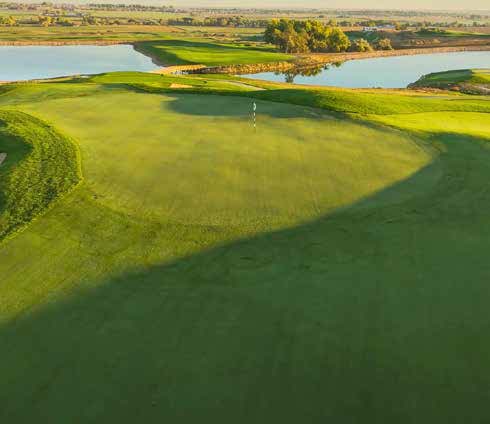
Among the biggest surprises players encounter comes after leaving the 10th green, when the back nine’s two large lakes suddenly appear. The final eight holes are creatively routed around these lakes, and Schaupeter added several playful quirks to keep golfers on their toes. No. 12 is a downhill par 3 stretching 261 yards from the back tees. Then No. 14 climbs uphill as a short par 4 measuring just a few feet longer—276 yards from the back tees. The fairway on 14 is a minefield of mounds and bunkers, and the only less welcoming terrain is the small, well-protected green guarded by even more bunkers and steep runoffs.
The No. 14 tee box is destined to host many humorous standoffs: “C’mon, be a man.” “Nope. You first; be my guest.”
In a nod to the owners’ former habit of hitting balls over their dairy cows, No. 15 is a par 3 built on the exact spot where the brothers used to practice. The hole is named “Genesis,” honoring the origins of the entire project. The course finishes with a series of mostly downhill holes, culminating in No. 18—a sweeping par 5 measuring 646 yards from the back tees. It finishes on a raised green protected by three runoff areas. Overall, Bella Ridge is a course that accommodates all skill levels—but choosing the right tee box is essential. Playing even one set too far back can make for a long day.
The course is managed by Troon. General Manager Ryan Flamm is a golf-industry veteran, and Superintendent Mitch Bryden previously spent more than a decade at TPC Colorado. Bella Ridge is the second new course Flamm has opened in his career.
“It’s a bit of a mindset; you have to be patient with the process,” he explained. “You have to think ahead of everything. You have to be pretty detailed and organized, and know that it’s going to be a mess. It takes longer than you think and it’s more expensive than you think, and nobody is an exception to that rule.”
For now, because Weld County Road 44 is being completely rebuilt alongside the course, visitors access the property via a long temporary gravel road from the south. The temporary clubhouse remains under construction, and a full permanent clubhouse won’t be ready for several more years. Guests park in a temporary lot and are shuttled by cart several hundred yards to the first tee.
Across County Road 44 lies the course’s expansive practice grounds. The driving range will include dozens of hitting stations, stretch 400 yards deep, and feature a separate short-game area and a 15,000-square-foot practice green.
“I think it’s one of the top in the state; the layout is amazing,” Flamm said. “There’s a little bit of something for everybody. The architect did a really great job incorporating where the game is today with pace of play, player development, and playability for golfers of all abilities. It attracts all kinds of people, and in 2025—with the sport’s growing popularity—it nails it all.”